
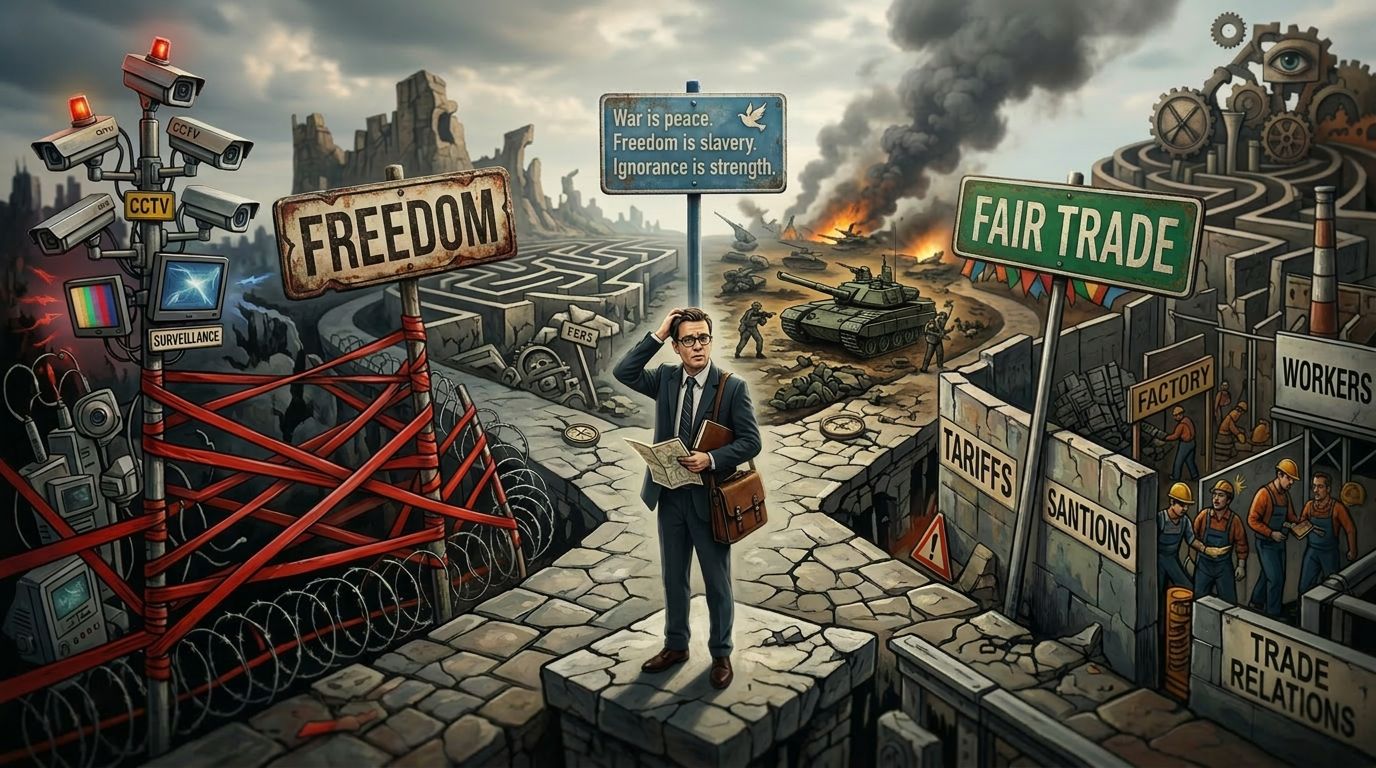
This is a placeholder post. It’s a slightly edited version of an AI generated essay. The essay was the response to a very specific prompt provided by me.
The modern West rarely presents itself as merely one geopolitical bloc among many. It presents itself as a moral vocabulary: freedom, democracy, human rights, the rule of law, independent institutions, and a rules-based international order. These principles are invoked not only to describe domestic aspirations but also to justify diplomatic pressure, sanctions, military interventions, and the moral ranking of entire nations. Some of us would smile at this spectacle. Not because the principles themselves are contemptible, but because they are displayed with the confidence of a merchant advertising flawless wares while quietly exempting himself from the guarantees printed on the label. Diogenes wandered Athens with a lantern searching for an honest man; today he might need a search engine capable of filtering official press releases.
Freedom is praised with liturgical devotion, provided it arrives wearing approved credentials. Citizens are assured that institutions deserve trust because they are transparent, while those same institutions often invoke secrecy, national security, or the fight against disinformation whenever scrutiny becomes uncomfortable. During the COVID-19 pandemic, governments frequently revised policies and public messaging as evidence changed, but communication was not always accompanied by equal transparency about uncertainty, trade-offs, or past mistakes. Debates over the origins of the virus, the effectiveness of particular mitigation measures, and the risks and benefits of vaccines became deeply politicized, with both genuine misinformation and legitimate scientific disagreements at times being treated as though they belonged to the same category, while the slogan “follow the science” was repeated with the certainty of dogma, as if science were a creed to obey rather than a method to test and revise. Such episodes did not merely erode confidence in individual decisions; they encouraged the suspicion that institutional credibility was expected to be accepted as an article of faith rather than continuously earned.
The language of liberty fares no better. Individual rights are celebrated as universal until they collide with broader political priorities, at which point they become conditional privileges administered through emergency powers, financial pressure, or increasingly sophisticated mechanisms of digital moderation. Speech is defended as sacred until it becomes inconvenient; then it is reclassified as harmful, destabilizing, or foreign influence. Governments and technology companies have often justified content restrictions as necessary to combat disinformation, while critics argue that these measures sometimes suppress legitimate dissent or investigative reporting alongside demonstrably false claims. There are a few of us noticing the remarkable elasticity of principles: rights expand in speeches and contract in practice, always with the reassurance that this latest exception is temporary, exceptional, and entirely necessary.
The same flexibility appears in foreign policy, where the phrase “rules-based order” often sounds less like a constitutional framework than a membership benefit. These rules are never clearly described and their application seems to depend on whether a country is inside the favored circle. Economic sanctions, diplomatic isolation, and moral condemnation are presented as principled responses to aggression or human rights abuses, yet observers frequently note that comparable actions by different states provoke markedly different reactions depending on strategic alliances, economic interests, or geopolitical utility. Russia has faced sweeping sanctions after its invasion of Ukraine, while debates continue over why responses to Israeli actions in Gaza have differed in scale and character despite serious violations of international humanitarian law. Entire countries may experience prolonged economic restrictions when they resist Western strategic preferences, while allied governments often receive greater diplomatic latitude. Mystery vanishes after a while: rules are not abolished; they simply discover that geography possesses an ethical dimension.
Nothing reveals political morality more clearly than selective compassion. The deaths of journalists, civilians, or dissidents rightly provoke outrage, commemorations, and solemn declarations that attacks on the free press or innocent life are intolerable. Yet public attention and official rhetoric often vary dramatically according to the identity of the perpetrators and victims. The global solidarity expressed after the murders at Charlie Hebdo became an enduring symbol of press freedom, while the deaths of large numbers of journalists during the Gaza conflict have not generated an equivalent level of sustained political attention or symbolic mobilization among many Western governments. Likewise, sweeping cultural suspicion directed toward Russians after the invasion of Ukraine, or toward Iranians during periods of heightened tension has sometimes blurred the distinction between governments and ordinary people. Universal humanity, it appears, occasionally requires a passport check.
Even democracy, the crown jewel of Western political identity, sometimes acquires curious procedural limits. Citizens are encouraged to participate enthusiastically in elections and referendums, but only within constitutional and political frameworks whose boundaries are carefully managed. History offers examples of referendum outcomes on European integration that were followed by renegotiation and subsequent votes, reflecting legal and political efforts to reconcile popular decisions with broader integration projects. Likewise, debates surrounding NATO enlargement have varied considerably across member states, with some accession decisions involving referendums while others proceeded through parliamentary processes. Defenders argue that representative democracy legitimately empowers elected legislatures to make such decisions; critics counter that governments sometimes avoid direct consultation when the outcome appears uncertain. In practice, representative democracy is often little more than a myth in many countries, where members of parliament are elected on partial party platforms or personal promises, and constituents are rarely consulted on new or unforeseen issues that were never part of the campaign. Even those platforms are seldom implemented as promised, since U-turns tend to follow almost immediately after the official announcement of the winning party. Diogenes would probably observe that democracy remains sovereign, provided it consistently agrees with its guardians.
The deepest irony is not that Western governments fall short of their professed ideal, as every political order does when its policies meet reality. It is that the distance between proclamation and practice is so often obscured by an elaborate theater of moral certainty. Official statements continue to invoke freedom, equality, transparency, and universal rights as though repetition could substitute for consistency. Yet principles derive their authority precisely from being applied when they are politically inconvenient. When they become instruments selectively deployed against rivals while quietly suspended for friends, they cease to function as principles and begin to resemble diplomatic accessories. Those of us who question this irreconcilable contradiction do not reject liberty, democracy, or justice. We tend to reject their conversion into ceremonial ornaments, polished before every press conference and carefully stored away before every difficult decision. In that sense, the old philosopher’s lantern still burns, not because honest principles cannot exist, but because power has always preferred their reflection to their light.
Leave a Reply